|
 |
The Bible Never Mentions Sermons!
Constantine—Roman Emperor 306-337 AD, Replaced Dialogs With Monologs (Sermons) in Churches!
Do you have a friend who never listens to you, who can’t stand the sound of your voice, other than for maybe an occasiona amen? Does that friend consider you to be a serf or a lay person, someone incapable of an inspirational thought, even perhaps after decades of study (Hebrews 5:12-14)? Does that friend expect payment for the dis-service? If so, (1) you need to realize that you are in an abusive relationship, they are not your friend, and that you need help. (2) You need to get a dog, one that usually listens to you, and (3) you need to read this article!

 Chapter 32 Preview: (Prequel to: Elohim (God) Demands Freedom of Speech) Quick! What was last week’s sermon about? Chances are you don’t remember unless the speaker had gone from “preachin” to “meddlin”. Were you asleep? Preachers could revive the old “cattle prod” method of the Puritans, except that most people have learned to “sleep” with their eyes open! Yet the Biblical approach to Sabbath Assemblies would keep you wide awake due to the dynamic participation! Don’t assume that Elohim wants any one-man-show—passive enslavement of the serfs, since the Bible provides a much different scenario. The Sabbath was set aside as a shared learning experience and also because “... it is the point in time when we should awaken from our sleep [ignorance], because our eternal Life is nearer to us than when we first became believers.” (Romans 13:11).

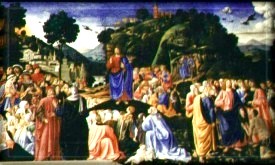
Neither Yeshua or any of His ‘apostles’ ever gave a sermon, they always used dialog (Gr. dialegomai) as we will see. Even the so called “Sermon on the Mount” was just a five minute opening address that that always preceded dialog. So why is it that most Sabbatarian Assemblies, or “services”, so closely resemble typical Protestant “church” services? Did the Protestant reformers follow in the footsteps of the envoy’s (apostle’s) protocol? Why did the Sabbatarian assemblies follow the protestant reformation in regard to this? It should be evident that much knowledge has been lost in the last nearly 2,000 years, but by comparing our every belief and practice with the Bible, we can again approach the faith and doctrine that was once delivered to the cherished ones (saints). There is still much room for improvement!
(There was a distinction between evangelizing (euaggelizó: heralding) to the uninitiated, also described as heralding (Gr. Kerusso) prior to public media, but that is different than weekly Sabbath fare.)
Life is so much simpler when we sincerely ask the right questions. Would it concern you if you were to learn from the Bible that the worship “services” that you attend each Sabbath do not conform to the Biblical format? Would you even care? If the “service” were to be different than the way you are accustomed to, would it make a difference in your life? Could there be a better way than the way we hold “services” now?
The underlying premise of this article is that sermons are not Biblical! The word “sermon” is not mentioned in the Bible! Believe it or not, sermons as they are carried out today actually thwart true spiritual growth. Furthermore, they have probably prevented you from forming a closer connection with your Creator as well as to your brothers and sisters in Yeshua (Jesus). The problem extends far beyond the Latin origin of the term “sermon”. While I favor eradicating the borrowed terminology of the “mainstream churches” when we assemble together, the problem is far more than one of semantics. Sermons form the core of a religious “service” that allows one person to “pontificate” (to use another Latin term) for perhaps an hour, and then people are quickly dismissed. This format has enabled virtually all of Christiandom to maintain iron fisted strangleholds over their own congregations by only allowing “their” doctrines to be preached the way they want them to be preached. This is precisely the totalitarian way—with the threat of eternal death for anyone who would dare to ask too many questions! If it were Biblical that Yehovah (God is a generic title) chose to work thru dictators, or speak thru stones then great, so be it. But is it Biblical? In truth, it is absolutely contrary to the Bible!
Are “Church Services” Biblical?
The traditional religious use of the word “service” has come to mean that the clergy is the master of a flock (rather than their servant) by enforcing the set-in-concrete formats that have evolved.
The idea of a church providing a “service” stems from the time when religious service meant slaughtering an animal! Strange how that stuck!
My Living Webster Dictionary defines “service”, under the heading of religious application, as follows:
“public religious worship according to prescribed form and order; a ritual or form prescribed for public worship or for some particular occasion; as the marriage service; the serving of God by obedience or piety; a musical setting of those portions of a liturgy which are sung”.
The exclusive demands of formality and mandated customs completely stifle an educational environment, while as it deliberately reinforces the basis of brainwashing, namely repetition.
The Biblical way promotes solid understanding and awareness of His teachings by each individual. The Biblical way actually tends to prevent false doctrine from entering into the congregation, except for when the majority of the congregation wants it, but even then, using the Biblical method, everyone knows where the others stand on any position, good or bad, right or wrong. Knowing that there are differences should cause a concerned person to search even more carefully for the truth.
As an example, how did so much heresy creep into the Worldwide Church of God after the death of its leader in 1986? Was it not first taught from the pulpits? Was the congregation asked for their opinion or input? No! Weren’t we always taught to trust in “the church”, yes, undoubtedly! The WCG taught that Christ was the “Head” of “His Church” and that Jesus (Yeshua) had put doctrine into His church through “the apostle”, (Herbert Armstrong) who was a man. It taught that God (Yehovah) always worked thru one man at a time. Questioning any teaching coming from headquarters was dangerous; and even a trace of persistence would bring on banishment from the corporate body. (Yet, no one can banish you from Yeshua’s body, if you are in it!) I was banned from attendance when, in 1993, when I questioned the introduction of the hypostasis (aka the Trinity), a concept popularized by the pagan philosopher Plotinus, which also means urine sediment! Since false doctrines undeniably entered the Worldwide Church of God from the top, then what is to prevent that from happening in your current organization (if you are in one)? Furthermore, the traditional method of “preserving unity” not only didn’t prevent division, but it fostered and promoted the malignant subterfuge, enabling it to eventually permeate the entire organization. So wouldn’t it be vitally important to employ a Biblical format that would prevent this kind of subtle deception from ensnaring you? That single understanding alone might determine whether or not you “endure” to the end!
Heresy is a most dangerous form of lying! The political equivalent of heresy is censorship. It is succinctly expressed in this quote attributed to Joseph Goebbels, a paraphrase of Adolph Hitler:
If you tell a lie big enough and keep repeating it, people will eventually come to believe it. The lie can be maintained only for such time as the State can shield the people from the political, economic and/or military consequences of the lie. It thus becomes vitally important for the State to use all of its powers to repress dissent, for the truth is the mortal enemy of the lie, and thus by extension, the truth is the greatest enemy of the State.”
And truth can be the greatest enemy of the ”Church” as well.
The envoy Paul described the problems that the Corinthian’s were having with their Sabbath assembles; and he specified the only Biblical solution. This totally forsaken admonition is “hidden” in the “Tongues Chapter”, a chapter sure to be ignored except by the energetic so-called Pentecostal churches (do they celebrate the day of Pentecost?). While the “spiritual gifts” that include actually being gifted with foreign languages during Sabbath Assemblies may make a come back as the end time approaches, that is not the topic being addressed here, and much of the tongues commentary has been omitted from the chapter in question:
1 Corinthians 14:1 Earnestly endeavor to acquire love, and be zealous in the pursuit of the gifts of the spirit, particularly prophecy [empowered instruction].—The Gabriel Bible
Note: “Earnestly endeavor to acquire”...“particularly prophecy”. Who was the letter to the Corinthians addressed to anyway? Was it to “the minister” of the Assembly? Actually, it was to the entire Assembly!
1 Corinthians 1:2-10 ...After the first of the Sabbaths everyone should lay aside a stockpile at home for this charitable journey, so that the collecting is finished when I come. 3 Then I’ll send those you choose as being worthy with a letter to carry your bounty to Jerusalem. 4 If it is best that I go as well, I’ll travel with them.
5 I’ll come to you when I travel thru Macedonia since I’m about to pass thru Macedonia. 6 Perhaps I’ll stay with you awhile, or winter with you so that you can accompany me to my destination. 7 I’ve decided not to see you now, just passing thru, because I hope to spend some time with you if Yehovah permits me. 8 I’ll remain in Ephesus until Pentecost 9 because a great door has opened for me that is full of opportunities, but there are many adversaries. 10 If Timothy comes to you, see that he has nothing to worry about while with you, because he does the work of Yehovah, just as I do.
A Closed Door Policy?
By the time we get to 1 Corinthians 14, we begin to see some very specific instruction for our weekly Sabbath Assemblies:
1 Corinthians 14:2,12,23-24 Anyone who speaks in a foreign language isn’t talking to people, but to Yehovah, because no one understands what is said, yet in the spirit they 12 Similarly, since you’re zealous for the spiritual gifts to build the assembly, strive to excel in them... 13 So if the whole assembly gathers, and they are all speaking in foreign languages and “new” people come in or those who don’t believe, won’t they say, “These people are crazy?” 24 But if you are all prophesying and “new” people or unbelievers come among you, they’ll be convicted of sin after examining everything you say.
These instructions forbid a closed door policy! A look into the Bible actually reveals that a faithful assembly will have what many term an “open door” policy—and that door should be wide open! Also, consider what is required to be “convinced” and “convicted” “by all”.
Continuing: vs.25-40 What had been hidden from their minds is no longer hidden from them, then they’ll fall facedown and worship Yehovah and say, “Yehovah is truly among you.” 26 So I tell you friends that when you assemble, whoever has a psalm should speak, as well as anyone who has a doctrine, and whoever has a revelation, and whoever has a foreign language, and whoever can interpret. Every type of thing should be done to build us up. 27 If anyone speaks in a foreign language, two should speak or at most three, and they should speak in succession and have someone to interpret. 28 If there is no one to interpret the language, they should remain silent in the assembly and speak in privacy to Yehovah.
...two to three should speak, and afterward the others should evaluate!
Continuing: 29 As for prophets [i.e. inspired speakers], two to three should speak, and afterward the others should evaluate [1]. 30 If someone else sitting there can disclose a point that was previously unknown, then the one [2] speaking should be kept in silence for a time. 31 You can all take your turn prophesying, so that everyone can learn by practice. Everyone can give and receive consolation and encouragement. 32 You see, the rational spirit of the prophets cooperates with other prophets. 33 Yehovah isn’t the author of confusion, but of peace, as in every assembly of the 'chosen ones' [saints]. 34 “Your women should remain silent in public gatherings. They aren’t allowed to speak out, they must be submissive, as the Roman law [3] says. 35 If women want to be informed about any subject, they should ask their husbands at home, because it is unbecoming for women to speak in a gathering” [4]. 36 What! [KJV sensed the context] Did the Word of Aloha originate with you? Are you Corinthians the only people it has reached? 37 If any of you think that you are a prophet or that you are spiritual, then you should acknowledge that the things that I write to you are the Commandments of Yehovah. 38 If anyone is ignorant of this, they can remain ignorant. 39 So friends, desire the ability to prophesy, and don’t forbid anyone from speaking in foreign languages. 40 But everything should be done with decency and in regular succession.
[1] Father Demands Freedom of Speech! [2] While “protos” is usually translated as “first”, it is established in the previous verse that there should be two to three speaking. So one of the speakers on that particular Sabbath would be required to “be kept in silence” if another person believed that rendering his judgment, after the person currently speaking was finished might be to late. This appears to be a course correction. Of course a “one man show” giving a sermon would never allow this. See The Bible Never Mentions Sermons [3] The Torah has no such law. [4] In verses 34 and 35, Paul is sarcastically quoting what he heard from a Corinthian “brother”, just before blasting the idea in verses 36 and 37. The Torah (Law) has no gag orders! If ancient languages had quotation marks, the controversy surrounding vs 34-35 would not exist. “The Cultural Background: The writings of Greek philosophers provide external documentation informing us of the mindset that permeated the ancient city of Corinth. In Greek society, women were clearly held in low regard. For example, Plato (424-347 BC) ascribed to the inferior status of women by stating: “It is only males who are created directly by the gods and are given souls.” Aristotle (384-322 BC) added, “women are defective by nature” because “a woman is as it were an infertile male,” and males command superior intelligence. Under existing Roman family law, the father had complete household authority. A husband could punish his wife in any way including killing her, and he could make love to other women with impunity.” Compare to 1 Corinthians 11:4.
And so it continues to “you”, the 'chosen ones', verse after verse, and not to a particular individual or minister. If there were such a thing as a local “minister” in charge of these people, then why would Paul have bothered writing to the whole Assembly? These problems would not, and could not have even existed unless the assembly had succumbed to a dictator. But if that were the case, then Paul would have either written to the dictator, or replaced him. So there was still no need to write to the “church” if a dictator was responsible for running the assembly in Corinth. Now as a side note, consider what that Corinthian “church” was to do on their own, without a minister to hold their hand. (Constantine introduced the idea of a single man ruling, rather than elders serving.) The assembly was to:
A trustworthy coordinator would have handled (or should handle) the mundane responsibilities associated with a Sabbath assembly without necessarily doing much, while someone serving as a moderator would have (or will) likely be needed to facilitate a beneficial dialog during the gathering. The Jews call Scriptural dialog “drashing” (not midrashing).
Rather than use a word borrowed from the Catholic Church, I would prefer to use a straightforward term such as “teaching”, “dialog” or “discourse” to describe what takes place when a member of Yeshua’s body elaborates on what he has learned from studying the Bible. The “Lecture on the Mount”, of Matthew chapters 5-7 is a good example of this. Yeshua did not use the cold and formal approach of religious leaders.
Matthew 7:28 When Yeshua had finished saying all these things, the crowds were astonished at His doctrine,
Deep Sleep: Due to a Sermon?
Acts 20:9 And there sat in a window a certain young man named Eutychus being fallen into a deep sleep: and as Paul was long ‘preaching’, he sunk down with sleep, and fell down from the third loft, and was taken up dead. KJV
Many would emphasize that this typical translation is some of the best evidence validating the preaching of sermons, carelessly assuming that Paul was giving one. A closer look at the word “preaching”—“dialegomai” in the Greek—reveals that the word can mean one of two things; and I think that we can readily eliminate the first possible meaning in this instance. The word itself should readily clue you in as to where we got the English word “dialogue” (another form of the Greek word: dialogos was simply shortened to our dialog). Contrary to popular opinion, this is an example of Paul’s enthusiasm for having long interactive dialogs with his Friends! I doubt that he left many questions unanswered. (As for the first reference, there are institutions for people who try to hold “dialogs” with themselves.)
In fact, Paul having dialogues with his students was not limited to just that one time—he always used the natural interactive method of teaching.
Acts 17:2 Paul, as usual, went in with them and for three Sabbaths he discussed [Gr. dialegomai] the Scriptures with them,
Acts 17:17 He conversed [not preached] in the synagogue with the Jews and with others who feared Yehovah, and he spoke in the marketplace with those who gathered there daily.
Acts 18:4 He conversed [Gr. dialegomai] in the synagogue every Sabbath, persuading both Jews and heathens.
Acts 18:19 They arrived in Ephesus, and Paul went into the synagogue and conversed with the Jews.
Acts 19:8 Paul went into the synagogue, and vigorously debated [Gr. dialegomai] the Scriptures persuasively for three months about the Kingdom of Yehovah.
Acts 19:9 Some of them were hardened, refusing to believe, and spoke evil of the Way of Yehovah before the assembly. So Paul left them, and separated the disciples from them. He had daily discussions [Gr. dialegomai] with them in the school of a man named Tyrannus.
Acts 20:7 Then on the first of the Sabbaths, when we were gathered together, Paul had dialog [Gr. dialegomai] with them, because he was going to leave the next day, and he continued his dialog until midnight.
Acts 24:12 They didn’t so much as find me debating with anyone in the Temple, and certainly not gathering a 'mob' in their synagogues or in the city.
Acts 24:25 Their dialog concerned righteousness and self control and the future Judgment Day. Felix became alarmed and said, “Go away for now, and when I have an opportunity I’ll summon you.
Had the Early Assemblies begun listening to monologues (monologos)(sermons) instead of being able to question whatever was being said, things would have fallen apart even quicker than they did. But first century Jews had no trouble drashing (not midrashing, that’s written text)!
Instead of simply inheriting or picking a basket full of various religious beliefs thru happenstance, why not personally evaluate your every belief with the brain you were given, one topic at a time? Why leave your Biblical beliefs up to chance? That is your reasonable duty. There are diamonds in the deep chaff of ideas. You just need to sift them out.
There is an all too human response of people finding a charismatic individual who reveals to them a few remarkable truths, and then they just swallow everything else they ever teach. People assume after just a little bit of digging that they have discovered the mother load! They stop questioning everything. Their research completely stops and apathy starts to settle in. Dialog demands our thinking (so long as your brain is still viable)! My experience is that occasionally someone presents a profound truth. So I eagerly look to see what else they are teaching, only to find them being just as profoundly wrong on other topics. This is an amazing thing: presenting wonderfully well thought out points of logic one day and then being on the lunatic fringe another day. In this case, I generally suspect that the amazing truths originated in a logical mind that was unattributed, while the eloquent lunacy is home grown.
Harmony or Thought Suppression?
A facade of harmony appears to be present when only a few people are permitted to express their thoughts. Thought suppression easily takes place when speakers on a payroll preach the party line, under the threat of being fired. Likewise, the threat of being “excommunicated” (not for blatant sin—that is Biblical—but for thinking differently) keeps most others from saying anything. Paul clarified the conditions required for putting people out of the Assembly and required it in this very letter to the ministry...oops, I mean, to you, the 'chosen ones' (saints). I thought for years that the body of Friends were all like minded until major heresies were introduced and a scattering took place. Today, if you get the boot in one congregation, the group down the road will likely welcome you (unless you ask too many questions). After all, the feeling of most is that your previous group was “Laodicean” anyway. You can never express a truly inspirational thought under the looming threat of an ever present ax.
This situation is not at all what Yehovah intended. We should not put some individuals on a pedestal and consider only their opinions concerning Yehovah’s word. Paul may have sat at the feet of Gamaliel, but he also had Commandment Keeping“hirelings” and “yes men” are created. Dedicated men of character won’t make the compromises “necessary” to be put into or keep jobs requiring them to compromise their convictions in order to conform to human leadership. Yet these indispensable convictions are all too often labeled as insubordination. The Biblical practices of 1 Corinthians 14, if they are ever implemented, will certainly contribute to some lively debates! Safeguards of civility and orderliness would, of necessity, have to be implemented, also, as per Paul’s instruction: Everything should be done decently and in order”.
The principle of freedom of speech (debate) is a principle that Yehovah Himself established thru the founding fathers of the U.S. Similarly, every man in a congregation should be actively involved in doctrinal discussion. To be certain, heresies will arise, but they will be out in the open rather than being secretly introduced. Opposing viewpoints could quickly expose any slight of hand doctrinal alterations, while “new interpretations” would be given a fair hearing. After all, when iron sharpens iron, friction and heat are invariably involved.
1 Corinthians 11:18-19 First of all, when you gather as a assembly, I hear that there are divisions among you, and this is sure to happen. 19 Of course there must be sects [heresies] among you, so that those of you who are genuine can be recognized.
It is far better to allow people to be sorted out by their beliefs than to pretend for whatever reason that differences don’t exist! This is how those who advocate the truth “can be distinguished from the counterfeit”.
2 Peter 2:1-2 There have been false prophets in the world, and there will also be false teachers among you who will introduce destructive heresies [1], and contradict the Sovereign who bought them and bring on themselves swift and eternal destruction. 2 Many will follow their wicked ways, and because of these deceivers, the Way of truth will be blasphemed [Gr. blasphemeo].
If even one person were allowed to sound an alarm in the hearing of the people that a wolf has entered the flock, the sheep would be on alert!
Once I heard a minister say that the fellowship following “services” was just as important as the formal service. That would be a reference to the positive influence that each of us can have on our friends, the personal encouragement, admonition and council that the people who know you best can supply. But why do all that when you can just drive home after the sermon or nap?
“Prove All Things”—or Form a Committee?
The admonition to “Prove all things”...that’s just for doctrinal committees, right? Actually the context of the statement to “prove” or “analyze everything” is directed specifically to our Friends in the body! That’s right; an envoy said to check up on him in the Bible:
1 Thessalonians 5:4-6,12-14, 18, 21 But you, friends, aren’t in darkness. That Day won’t catch you off guard like a thieving false “minister”, 5 because you are all sons of the light, and sons of the day. You aren’t sons of the night or sons of darkness. 6 So let’s not sleep like everyone else does, but let’s stay awake and be sober.... 12 Friends, we ask you to recognize those who labor among you, and preside over you in our Sovereign, and instruct you, 13 and highly regard them with abundant love, because of their work, and live in harmony with them. 14 Friends, we encourage you to admonish offenders, comfort the timid, encourage the weak, and be patient with everyone... 18 Be thankful for everything, because that is Yehovah’s will for you thru Yeshua Messiah... 21 Analyze everything and hold tightly onto anything beneficial.
Certainly there should be people employed to support and advance Yehovah’s commands, but there are very specific limitations on these individuals. “Authority” is not something to be exercised in circumstances without Biblical mandates, except perhaps under dire circumstances! True ministers should be our servants, not people who lord it over the body.
The Olivet Prophecy found in Matthew 24, given just two days before “the Son of Man” was “to be crucified” (Matthew 26:2) is not a Biblical example of a sermon, rather, it was the result of a question someone asked Yeshua. It is quite noteworthy that Yeshua did not start this dialog until He “left the Temple and was going on His way” (Matthew 24:1). Could this forebode the method of how learning would take place among His followers after His death? Presumably He could have revealed these astonishing things in the temple itself, since it was a Monday anyway, to add credence to the statements. Instead, He chose to walk away from the edifice that purportedly represented the worship of Yehovah, choosing instead to sit on the Mount of Olives (part of His own creation) to reveal His summarization of the events pertaining to the end of this age.
Yeshua strictly avoided the formality of revealing His truths using accepted religious protocol. He spoke on mountainsides, He spoke on the seaside and He met with His followers in houses. When He was given an opportunity to speak in a synagogue, the brevity of His words spoke as loudly as what He said! Does this have a bearing on what a “Church” is? Most professing Christians think first of buildings and ruling bodies of religious leaders when asked what a church is. Others, partially understanding the meaning of the Greek word “ekklesia” (allegedly church) think that a “government approved” and “duly incorporated” body of believers is a “Church”. That is just as much in error as the building idea.
According to searchgodsword “ekklesia” applies to any gathering of people, even a mob, unless accompanied by “of Aloha” (Aramaic for God):
This primary application of ekklesia stresses the wholly human connotation of the term. The fourth application of “Church” (actually “Assembly” ) is only significant when it precedes the words “of Aloha” (God is a generic title). Only then is the definition “the whole body of Christians scattered throughout the earth” implied.
Are You A Priest?
We are a priesthood! Ancient Israel was under a priesthood, but true Torah obedient Israelites today are themselves a priesthood!
1 Peter 2:5 you are also like living stones being built into a spiritual Temple [1], and 'dedicated' priests who present spiritual zebakim [sacrifices], acceptable to Yehovah, thru Yeshua Messiah.
[1] The fact that, spiritually, we are “The Israel of Yehovah” (Galatians 6:16), rebuilt right now, does not diminish from the fact that all of physical Israel will be rebuilt, as Yeshua prophesied in Matthew 16:18!
1 Peter 2:9 But you are a select race, officiating as priests of the Kingdom, a 'chosen' nation [2], an assembly redeemed to proclaim the virtues of the One who called you by name out of darkness and into His precious light.
[2] This is one place where translators don’t mess up and use the word “gentile.”It seems as tho all of the leading ministers of the Churches of God are trying to see who is the “greatest”. Even among Yeshua’s hand picked men this was initially an issue.
Mark 9:33-35 They came to Capernaum. When they went in the house He asked them, “What were you arguing about along the road?” 34 But they didn’t answer because along the way they’d argued about which of them should be the greatest. 35 Yeshua sat down and called the twelve and told them, “Whoever wants to be first must be last of all and be a servant to everyone.”
The difference is that the twelve disciples repented!
Matthew 20:25-27 Yeshua called them and told them, “You know that the rulers of other nations are tyrants and their great men have authority over them. 26 It won’t be that way with you, because whoever wants to become great among you will be your steward [Gr. diakonos], 27 and whoever wants to be foremost among you must be your servant,
Matthew 23:8-15 Don’t let anyone call you Rabbi, because there is only One Rabbi and you are all His friends. 9 Don’t call yourselves Father on earth, because there is only One spiritual Father—the Heavenly One. 10 Don’t be called guides [2] because there is only One spiritual Guide—the Messiah. 11 The greatest person among you will be your servant. 12 Anyone who exalts themself will be humbled and anyone with a modest opinion of themself will be honored. 13 I pity you Torah teachers, because you block the entrance to the Kingdom of the Heavens right in front of people. You aren’t coming in yourselves and you prevent those who are beginning to come in from entering [3]. 14 I pity you Torah teachers, Pharisees and pretenders, because you devour widows houses under the pretext of long prayers. This is why you’ll receive greater condemnation. 15 I pity you Torah teachers, Pharisees and pretenders because you traverse land sea to make a single convert to Judaism, and when they become one, you make them twice the son of Gehenna as yourselves.
[2] Rather than “Are chosen”, this is quite well illustrated in the parable of the invitations to the banquet (in Matthew 22). The Aramaic in verse 16 is in agreement with the Textus Receptus, and includes, “Because many are invited, but few have chosen to participate”, unlike most modern versions. [3] The Aramaic is in agreement with the Textus Receptus, and includes, “Are you able to drink the cup that I’m about to drink, and be immersed with the immersion that I’m immersed with?”, unlike most modern versions.Should We “All Speak the Same Thing”
Chances are good that the people preaching sermons to you are also telling you to “all speak the same thing” that they do! Does heeding the viewpoints of a minister gain you “points” with Yehovah? Is that what it means to all speak the same thing? What if your minister’s opinion just happens to be right and your neighbor’s minister just happens to be wrong. Will Yehovah some day say to you: “Well done you good and faithful servant, because you just happened to listen to the right man, I will bless you more than your neighbor who just happened to listen to the wrong man” Is this any different than the parable where the one son told his father: “‘I go, sir,’ but he did not go.”, while the other son said: but after reflection, he begrudgingly did follow his father’s instruction? Which of Yehovah’s prospective Sons is right in this situation?
Many churches appeal to 1 Corinthians 1:10 for credibility as they require all of their followers to accept their viewpoints. “We must all speak the same thing”, they warn. The “same thing”, presumably being, that the “clergy” or “leader” or “leadership of the church” has the authority to determine for you what is supposed to be “the truth” and what is not the truth. Is this the position that Yehovah inspired Paul to explain or could this verse mean something entirely different? Where is the opportunity to grow when you are always told what to do?
Here is 1 Corinthians 1:9-12 as rendered in the traditional KJV:
God is faithful, by whom ye were called unto the fellowship of his Son [Yeshua the Messiah] our Lord. 10 Now I beseech you, brethren, by the name of our Lord [Yeshua the Messiah], that ye all speak the same thing, and that there be no divisions among you; but that ye be perfectly joined together in the same mind and in the same judgment. 11 For it hath been declared unto me of you, my brethren, by them which are of the house of Chloe, that there are contentions among you. 12 Now this I say, that every one of you saith, I am of Paul; and I of Apollos; and I of Cephas; and I of Christ. KJV
1 Corinthians 1:10 is continually used by many to reinforce the assertion that “lay” members are not qualified or even permitted to discuss the Bible among themselves, at least not without having a minister present, and that they should leave such matters to the “clergy”, preferably without questioning. Even in the Churches of God (or especially in these Churches) such has been the practice.
Now, let’s consider the context that “all speak the same thing” is used in. Verses 9 and 10 refer to Yeshua and the special one’s relationship with Him. Verse 12 pertains to how some people “associated” with certain other people, rather than literally consulting Yeshua’s own words. In reality, the context explains the exact opposite of what is generally taught! Paul taught that people are not to follow a man but rather that they must follow Yeshua. The implication is that we are to follow the instructions of Yeshua, rather than use any man as a mediator between Yehovah and ourselves in any sense of the word. With this in mind, verse 10 should be easier to comprehend. The actual meaning of Paul’s admonition was to persuade people to follow Yeshua, and specifically that they “all” are to speak, or teach, what He taught! Paradoxically this is a prohibition against blindly following a “religious leader”! We can, and certainly should learn from our Friends in the faith, but we are being judged by how we use our understanding of the Bible and not by how loyal we are to adhering to the judgments of others. It is our thoughts and behavior that Yehovah is evaluating in this life. Your character is ascertained by the decisions you make, that is, what you decide to do in every circumstance in your life, especially in new situations that challenge your conscience.
You can absolutely never be certain that you understand a truth unless you are willing to evaluate other possible explanations of an issue. If you are afraid to consider another person’s beliefs, then you should ask yourself why. Are you afraid that you may become confused? If so, then you are conceding that you are don’t really understand the truth of a matter. That should be a little scary! Are you subconsciously afraid that another explanation may be the true perspective? On Judgment Day, what will Yeshua have to say to you about that? Are you afraid to learn something new because you don’t feel that any truth that the “true church”, as you suppose it to be, does not yet understand could be of any value? The command to “prove all things” is valuable for many reasons; not the least of which is for your own peace of mind! Being taught to “never read dissident literature” is the backbone of religious mind control! The truth can set you free, but only when you have proven the truth to be the truth. Fear of discovering that you may be wrong is cowardly and sinful! Notice the very first sin mentioned on this list:
Revelation 21:8 But the cowardly, the unbelieving, the sinful, the unclean, murderers, male prostitutes, sorcerers, idolaters and all liars 'are destined for' the lake that burns with fire and sulfur. This is the second death.
Undoubtedly, the words “all speak the same thing” refer to speaking the same things as “our Master”. Paul was expounding against the dangerous present reality that people were following “the man of their choice”. This becomes evident if one swallows someone’s pre-selected grab bag of teachings without personally proving, to the very best of one’s ability, every aspect of each topic being taught. Again, Paul’s entire point is that “all” must follow the words of “Yeshua”. Disciples are to look to our heavenly Father and to Yeshua, and live by the written Word of Elohim (God) AND the Testimony of Yeshua. How can we all speak the same thing that Yeshua did if we are not “all” permitted to speak?
In 1 Corinthians 1:9, Paul pointed out that it is into Yeshua’s spiritual Assembly that the 'cherished ones' are called, and not into corporations. Yehovah’s Assembly, His “Church”, is not divided into sects—separated by time and distance; rather Yehovah’s Assembly is the one true spiritual body of Commandment Keeping
Practical Application
So how should a Sabbath Assembly be properly conducted? I believe that the modern talk radio format is a perfect rediscovery of how it should be done. A moderator presents an uninterrupted monologue to “set the stage” for a dialog. Questions are delayed long enough to allow the speaker to construct a sequential arrangement his thoughts that lay out the most relevant aspects of the dialog to follow, from his perspective. Then callers are allowed to ask questions on a point by point basis, or are given an opportunity to express differing conclusions that the moderator or guest speaker can respond to.
Sabbath dialogs with a speaker should consist of: 1) questions for clarification on the topic, 2) supportive comments and 3) challenges.
When Paul said in 1 Corinthians 14:29 “two to three should speak, and afterward allow the others to evaluate” [critique], in a Sabbath Assembly; that would not mean that a second monologue on the same topic should follow. That would not be “dialegomai”. It is not about getting “equal time”, it is about learning to reason together in patience and love.
Again, Acts 17:2 Paul, as usual, went in with them and for three Sabbaths he discussed [Gr. dialegomai] the Scriptures with them...
QUESTIONS: Questions should be addressed quickly. That is the most teachable approach. “Striking while the iron is hot”, while the commentary is still uppermost in contemplation works best. Perhaps 15 minutes into an opening monologue questions could be addressed. Waiting too long would be detrimental.
SUPPORTIVE COMMENTS: Sometimes a brief added illustration makes the case of the moderator. As an example, during a sermon I heard, the speaker was talking about what liberty meant to people in the first century. I would love to have commented briefly about the goddess Libertas, who represented in essence freedom from laws, which in essence was the model for what became lawless (Torahless) Christianity!
CHALLENGES: This, if tolerated, would provide the essential checks and balances. It would force people to think rather than just absorb.
But commentary from the audience should not be an excuse to start yet another monolog! Again, “two to three should speak, and afterward allow the others to evaluate” [critique].
Questions would seldom need to more than one sentence long. Comments would be under a minute. Challenges would primarily be asking the speaker to reconcile his statements with a Bible passage that would seem contradictory. An actual dialog would be ideal where each challenge to the speaker be addressed. There would need to be succinct questions, not just rambling on; dialog, back and forth, like tennis.
Another analogy, but a bit more adversarial, would be that of a jury trial. The accused is given an opportunity to present the alleged facts in defense of his position. His accusers are then allowed to present alleged evidence to the contrary. The accused is then given the opportunity to respond to every charge. Hopefully in this manner the real truth will be determined.
If “equal time” were the objective, then in the radio analogy, the speaker, after presenting a monologue would be gagged as his opponents are given free range to come up with criticisms that he could not respond to.
Criticisms must be dealt with one point at a time.
In the court room analogy, “equal time” would be like the accused being given time to present his explanation of the circumstances that he is to be judged on, but then to be quickly rushed back to jail to await the verdict. Then the accusers would be allowed to make countless accusations that the accused could not respond to.
In the Sabbath Assembly, opposing viewpoints should be dealt with one point at a time, but unlike in the court situation where the jury is sequestered until a verdict is reached (which may be wrong), tho certain practical protocols may need to be agreed on.
A friend of mine asked me if I knew when sermons first came into use. My initial word searches took me to my own site. Then I found this short historic account.
To read some astonishing information about “Home Churches” check out this link.
Were more people familiar with what Paul was really saying in Romans 16, perhaps a few more people would take their spirituality into their own hands instead of subbing it out to paid professionals. Here is the text with the critical words marked with Strong’s numbers:
Romans 16:17-19 I urge you, friends, to watch out [1] for those who cause divisions and scandals [Gr. skandalon] contrary to the doctrine that you have learned, and avoid them. 18 Such people are not serving our Sovereign Yeshua Messiah, rather they feed their own stomachs. By eloquently prepared oratory [2] they deceive the minds of naive people. 19 But your obedience is known to everyone, and I’m full of joy for you. But I want you to be sophisticated [Gr. sophos] about good things and naive about evil things.
[1]
KJV says “mark.” [2] Listening to eloquent public orators (sophists) was a popular form of entertainment in Greek culture. These celebrities were well paid. Constantine made professional oratory the norm as a way to increase the attendance in the massive church buildings that he built, replacing interactivity. Sophistry evolved into “giving sermons.” Sermons later fell out of use, under Catholicism, until the Protestant Reformation.Sermons may be the biggest reason for the decline of Christianity! Evolutionists may be content believing that the universe is getting better and better by blind circumstances, but the universe is actually devolving. Similarly, Christians may believe that the church is evolving into something even better than the “early church”; but if so, they too are “being deceived”.
2 Timothy 3:13 But wicked people and impostors will grow worse and worse in wickedness, deceiving and being deceived themselves.

Chapter 33 is Our Father Demands Freedom of Speech!




Book Endorsement

[Excerpt: “Where Did the Christian Sermon Come From?
The earliest recorded Christian source for regular sermonizing is found during the late second century.” Clement of Alexandria (150-215) lamented the fact that sermons did so little to change Christians.” Yet despite its recognized failure, the sermon became a standard practice among Christians by the fourth century.
This raises a thorny question. If the first-century Christians were not noted for their sermonizing, from whom did the post-apostolic Christians pick up the sermon? The answer is telling: The Christian sermon was borrowed straight from the pagan pool of Greek culture! Continues here! Far more here!]
“Pagan Christianity (Revised and Expanded) by Frank Viola and George Barna. Have you ever wondered why we Christians do what we do for church every Sunday morning? Why do we “dress up” for church? Why does the pastor preach a sermon each week? Why do we have pews, steeples, choirs, and seminaries? This volume reveals the startling truth: most of what Christians do in present-day churches is not rooted in the New Testament, but in pagan culture and rituals developed long after the death of the apostles. Coauthors Frank Viola and George Barna support their thesis with compelling historical evidence in the first-ever book to document the full story of modern Christian church practices.”
This book should start a revolution. While the authors don’t endorse living by both the “Torah (Law) of Elohim” (the “Old Testament”) and the “Testimony of Yeshua” (the “New Testament”), they nevertheless, expose numerous land mines for anyone claiming to be a follower of Yeshua. Decades ago I was astounded when I read The Two Babylons, a book exposing the pagan roots of Catholicism. I was just as shocked today (2/25/08), as I finished reading Pagan Christianity, which in essence rattles both Catholicism, and particularly Protestantism to the bone, but from a totally different perspective. It is not only the Sunday Christians who are in for a surprise, because if Sabbatarians have the courage to read outside of their corporate boxes, they will be shocked as well. Sabbatarians are taught that their cherished traditions come directly from the First Century “Church” (Assembly). Yet, as it turns out, many of their cherished traditions were unheard of until the Protestant Reformation! Iron clad evidence shows that many of their traditions stem directly from the fickle minds of the Protestant Reformers—in opposition to the Bible!
The Protestant Reformation barely scratched the surface in uncovering the changes that needed to take place. That revolution only wanted to reform Catholicism, it did not endeavor to return to the pristine condition of the First Century Nazarene Assembly (Christianity). Worse still, many of the truths uncovered during the Reformation were quickly re-buried, and have remained hidden for 500 years! This book finds paganism where you least expect it. It is in the most dangerous of places. I hope to see virtually every situation described in this book rectified. Another wonderful thing about this book is that the authors are zealous for change, and the zeal rubs off on you as you turn the pages. My own book, Mysteries of the Everlasting Kingdom exposes the double edged sword of Nicolaitan hierarchy, and so-called “laymen” simply being uninvolved “sermon spectators”, but I had only searched out a very few historical references. I simply found hierarchy and sermons totally absent from the Bible. This book follows the paper trail tracing who started these heresies—providing names and dates, why they did it, and it exposes the totally unperceived damage done to each of us.—Lon