Yehovah's Modern English Scriptures

Yehovah’s Modern English Scriptures—Index

The Testimony of Yeshua—Original Peshitta (& Greek) Order


From the Aramaic, Harmonizing and Contrasting the Greek (formerly the NMT)


FORWARD

“The world has never had a complete Bible of the Old and New Testaments in the original manuscript order of the biblical books. This is a fact! It is almost unbelievable that such a non-manuscript arrangement of the books of the Bible could exist, but all modern translations of the Holy Scriptures do not follow the early manuscripts. Publishers in their quest to print numerous versions of the Bible have been led to avoid the manuscript positioning of the biblical books in favor of an ecclesiastical order which has no justification from the early Hebrew and Greek manuscripts of the Bible.” —Restoring the Original Bible, Ernest L. Martin, Ph.D.

“Our English Bibles follow the order as given in the Latin Vulgate. This order, therefore, depends on the arbitrary judgment of one man, Jerome (A.D. 382–429). All theories based on this order rest on human authority, and are thus without any true foundation.” —Companion Bible, Appendix 95, p.139

Index
Index & Forward

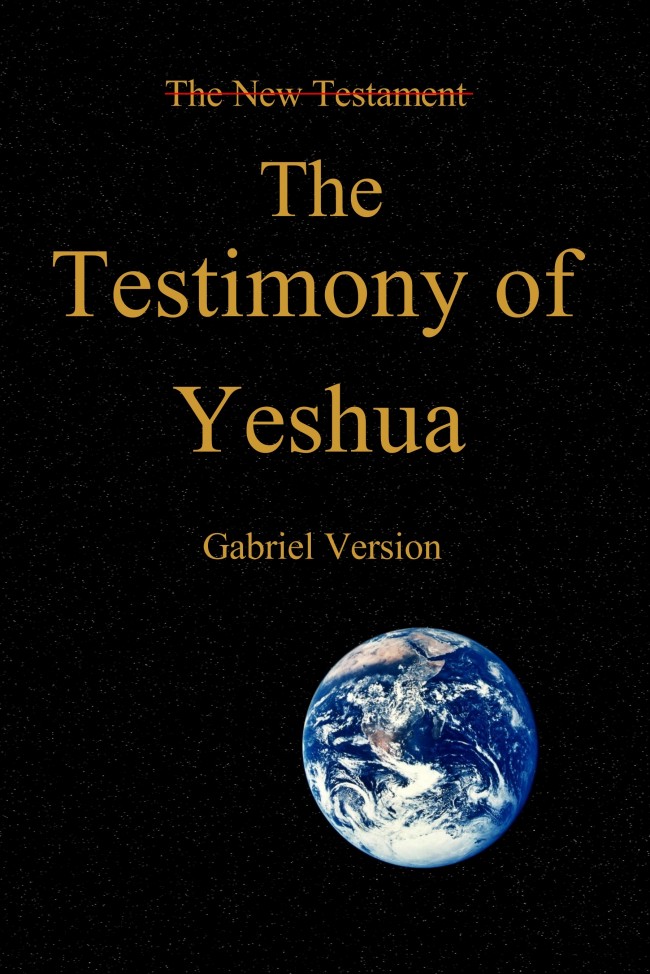
I do not use the term “New Testament” except to explain the error in using it. (Testament is not a synonym for covenant and the New Covenant is not a book.) Tertullian was the first to apply the term “New Testament”, to the newer Messianic Scriptures, and “Old Testament” to the Hebrew Scriptures. This terminology implies that the newer Scripture is superior to all previous Scripture, rather than the completion of the whole. Yet the Messianic Scripture is additional Scripture, it complements all previous Scripture. It is the end of the inspired Testimony. At least the word “Bible”, a 4th century substitution for “Scriptures”, does not have built in confusion.

Romans 10:4 For the Messiah is the *aim and purpose* [5056] of the Law, for righteousness, for everyone who believes in Him. YMES

 
5056 telos (tel’-os)
from a primary tello (to set out for a definite point or goal); TDNT-8:49,1161; n n
1) end
1a) termination, the limit at which a thing ceases to be (always of the end of some act or state, but not of the end of a period of time)
1b) the end
1b1) the last in any succession or series
1b2) eternal
1c) that by which a thing is finished, its close, issue
1d) the end to which all things relate, the aim, purpose
2) toll, custom (i.e. indirect tax on goods)

Prior to his new terminology, there was no concept a deep chasm separating the “New Books” (documents & letters) from the Tanak (Hebrew Scriptures) nor were the newer documents thought to have anti Semitic overtones. I refer to the newer Messianic Scriptures as “The Testimony of Yeshua-Messiah” because the apostle John seemingly called it that. He was the last surviving apostle and evidence indicates that he finished “canonizing” the “The Testimony of Yeshua”. (Overwhelming evidence for Apostolic “canonization”, rather than Catholic, can be read in Ernest Martin’s above mentioned: book). John used the term “the Testimony of Yeshua Messiah” three times and “Testimony of Yeshua” twice, after he had established the term.

Revelation 12:17 The dragon was *provoked to anger* [3710] against the *wife-to-be* [1135]; and he went to war against her remnant* [3062] survivors* [4690-1b], who keep the Commandments of Yehovah’, and have the Testimony of Yeshua. YMES

Revelation 19:10 I fell at his feet, to worship him. But he said to me, “See that you dont do that; for I *serve the same God* [4889]. I’m your brother* who also adheres to* [2192] the Testimony [3141, or “documentation”] of Yeshua. Worship Yehovah; for the Testimony of Yeshua is the *empowering spirit* [4151] of the *inspired declaration* [4394, see below]” (also: Revelation 1:2; 1:9). YMES

Strong’s 4394: “1a a discourse emanating from divine inspiration and declaring the purposes of God, whether by reproving and admonishing the wicked, or comforting the afflicted, or revealing things hidden; esp. by foretelling future events”)

Revelation 6:9 When he had opened the fifth seal, I saw under the altar the bodies* [5594] of those who were slain because of the Word of Yehovah [1], and because of of the Testimony of the Lamb [2] that they held. YMES

[1] John 10:35 “The Word of Yehovah” (God) refers to either the Hebrew Scriptures or God’s spoken word: the Tanak (off site). Claims of people hearing God’s actual voice are quite overrated.

[2] The “Testimony of the Lamb” is apparently another descriptive reference to the collective inspired documentation that we have concerning Yeshua—the so-called “New Testament”.

As soon as I read the book Was the New Testament Really Written in Greek? I came to believe that the New Scriptures were really translated from the Western Aramaic Peshitta into Greek and not the other way around. But there is not a contemporary English version of the Peshitta available without copyright restrictions (unless there is a really obscure one, like this). To remedy this, I immediately decided to update Murdock’s 1851 public domain translation. My first task was to word process out most of the obsolete English wording and phraseology. That is virtually finished. Upgrading the writing style and comparing it with the Greek is taking much longer. This version will always be free, as noted below.

A TRANSLATION IN PROGRESS: When I first began reading the Aramaic to English translations, I thought that there would be some startling differences from the Greek texts, and many new insights. I have not found this to be the case. What I have found to be startling is the number of nuances lost by English translators going from the Greek texts to the English translations. While the YMES’s Testimony of Yeshua is based on Murdock’s Peshitta, I am of necessity checking it against The Online Bible Greek Lexicon because there is no comparably thoro Aramaic lexicon. It is an incredibly powerful tool. It uses Strong’s numbers to locate definitions of Greek words, but it is far more “exhaustive” than the original 19th century Strong’s Exhaustive Concordance (now on line) that I used for decades. This accounts for all of the [bracketed] Strong’s numbers in the YMES text. After spending hundreds of hours comparing various Aramaic and Greek translations, side by side, I can say with certainty that the objectivity of the translators has a far greater influence on a translation than whether or not they prefer Aramaic or Greek texts! Still, it is nice to eliminate some of the bugs lost in the translation from Aramaic to Greek. Virtually anything of note in the translation of the YMES is marked with an *asterisk, a [Strong’s number], a footnote[] or a link.

There was a controversy among the Jews as to what to do when they found a copy of the Testimony of Yeshua. They were concerned because the tetragrammaton, YHVH (Yehovah) in Paleo Hebrew form, was inserted into all of the original “Minim” (Messianic/Nazarene/Christian) copies of the Testimony of Yeshua in the the Aramaic, Greek and even Latin copies. Some wanted to burn them intact, while others insisted on removing each instance of the Divine Name prior to burning the books. That the Divine Name of Yehovah was present in the original copies of the “Testimony of Yeshua” (the so-called “New Testament”) is apparent in the Jewish Babylonian Talmud:

“It was stated in the text: The blank spaces and the Books of the Minim, we may not save them from a fire. R. Jose said: On weekdays one must cut out the Divine Names which they contain, hide them,17 and burn the rest. R. Tarfon said: May I bury my son if I would not burn them together with their Divine Names if they came to my hand. For even if one pursued me 18 to slay me, or a snake pursued me to bite me, I would enter a heathen Temple [for refuge], but not the houses of these [people], for the latter know (of God] yet deny [Him], whereas the former are ignorant and deny [Him], and of them the Writ saith, and behind the doors and the posts hast thou set up thy memorial. 19 R. Ishmael said: [One can reason] a minori: If in order to make peace between man and wife the Torah decreed, Let my Name, written in sanctity, be blotted out in water, 20 these, who stir up jealousy, enmity, and wrath between Israel and their Father in Heaven, how much more so; 21 and of them David said, Do not I hate them, O Lord, that hate thee? And am I not grieved with those that rise up against thee? I hate then with perfect hatred: I count them mine enemies. 22 And just as we may not rescue them from a fire, so may we not rescue them from a collapse [of debris] or from water or from anything that may destroy them.”

The YMES is the only version that honors His actual name.

Have you ever read the copyright statement in your Bible? Some of them bind the Scriptures with heavier chains than others, but always to make a few shekels. Here is what one Aramaic “New Testament” copyright has to say:

“All rights reserved. Printed in the United States of America. No part of this book may be used or reproduced in any manner whatsoever without written permission except in the case of brief quotations embodied in critical articles and reviews.”

This is a serious situation. Imagine what the ultimate penalty might be for putting a lock on the truths of God! While the following Scripture might not be an exact fit—perhaps it is!

Revelation 22:19 If anyone takes away from the words of this book of prophecy, ‘God’ [Yehovah] will take away his destiny* [Strong’s 3313] from the tree of life, and from the holy city that are described in this book. YMES

In verse 10 there is another caution:

Revelation 22:10 Then he said to me, “Dont seal [or silence] the words of this document of prophecy, for the end time is near. YMES

By contrast, the prophecy of Daniel was sealed because when it was given, it was not the end time:

Daniel 12:4 But you, Daniel, shut up the words, and seal the book, even to the time of the end, many shall run back and forth, and knowledge shall be increased. WEB

If the penalty for “sealing” the book [document] of Revelation is this serious, then imagine how serious it is to seal the entire Testimony of Yeshua (everything His apostles recorded), particularly near the end time!

Matthew 10:8 ... Freely you have received; freely give.

So here I go with my little seal cutter.

This is my best shot, but refinements to this version will remain a work in progress.

I know that believing in what is called Peshitta primacy makes me an “extremist” and “unorthodox”, but every chapter in Mysteries of the Everlasting Kingdom would be classified as such by “orthodox” Christianity. I’m used to being painted with that brush.

Originally I only intended to update the Murdock Translation of the Testimony of Yeshua (calling it the New Murdock Translation) and use the World English Bible for all of my quotations from the Hebrew Scriptures on this site. I had been substituting the WEB’s use of the name “Yahweh” with Yehovah in brackets[], but this alone accounts for over 5000 changes to the text of the WEB. The WEB website requests that if any changes are made to their public domain text, that it not be called WEB, so I will be replacing all of the bracketed WEB quotations on this site. The YMES copy of the Hebrew Scriptures, very heavily based on the WEB will remain, at least for now, just on my computer, except for the quotations that are in the chapters of my book Mysteries of the Everlasting Kingdom. In fact any significant differences between the text of WEB and the YMES will be indicated by *asterisks* just as is done with variations between the Murdock Translation and the YMES Testimony of Yeshua. While I really like the WEB version, it still has a considerable KJV flavoring that is not what I would call “standard English”. So even words like “shall”, which hasnt been used since General MacArthur said, “I shall return”, will be changed to “will” and many other rewordings that do not affect the meaning.

Most people dont know that the KJV Bibles being printed today have been updated four time. In 1901 it was revised again and renamed the “American Standard Bible”. Updates of the American Standard include the copyrighted RSV, the NKJV and the public domain WEB. I will over time remove all quotations from the NKJV as well, because I want to move away from versions that restrict quotations of the Holy Scriptures.

Consultation with various translational references will be ongoing, but only in the spare time I can devote to it. Again, for now, I am reasonably content that most of the old English is already removed and that it is free to use and download. A little bit of poor grammar is the result of replacing dozens of obsolete words with a single key stroke. The poor grammar, tho quite comprehensible, will need to be edited, one line at a time.

A burning issue is the idea of paraphrasing. In essence all translating is paraphrasing—taking a foreign word or phrase and replacing it with what is, hopefully, the equivalent words or thoughts in another language. The major obvious difference is the flavor! Using obsolete words to flavor a translation adds credibility in the minds of many; but is that logical? Another flavor is using foreign sentence structuring; in essence the sequence of the words. Unusual word order, foreign to your language does not necessarily add anything that the Scriptures were intended to reveal. Yet, when paraphrasing becomes liberal rather than literal it becomes a sin! The best translation would answer the question, “What would Jesus (Yeshua) do”. A version can be very accurate, without being word-by-word “literal”. Word-by-word is actually a poor method of translating if the objective is more than simply to convey isolated facts.

Reading the Scriptures should be so overwhelming that it is literally to die for! Being willing to both live and die for your beliefs requires emotional maturity. Do you feel multiple passions while reading God’s very words? That is the goal and this work is by no means there, at least yet. While tripping over awkward phraseology, you lose much of the emotional impact that should be inseparable from the facts.

Scripture reading should not be like reading something from a stodgy academic linguistic puzzle, fitting together individual words retrieved from a cave, from a nearly dead language. The Scriptures are a living message, for all time, inspired and sent to you from heaven by the very living God!

Understanding the Scriptures doesnt require understanding foreign language word structures so long as the translation is HONEST! It is only by checking the more critical words in a lexicon that you can determine the honesty. Using a lexicon can be better than learning Aramaic or Hebrew or Greek as your second language. How many times do we use words in our own language correctly, knowing all of the possible nuances of our less often used words? Using proper English requires knowing your way around a dictionary.

There is an interesting website devoted to Bible translation theory. While their perspective assumes the need for hierarchy and Greek originality (supremacy), it is still interesting, at least for me, to consider the goals of the mainstream translators. The most literal translations are termed “formal equivalence”. The loosest paraphrases are termed “dynamic equivalence translations”. Note these comments from the site:

“Translations can be located on a spectrum, which would have, at one extreme, rigid adherence to the form of the original language (formal equivalence)...

At the other extreme:

“There are problems, however, with dynamic equivalence translations. Since the translator is “freer” from the grammatical forms of the original language he is more likely to exceed the bounds of an accurate translation, in an effort to speak naturally in the native language. That is, the dynamic equivalence translations are capable of being more natural and more precise than are formal equivalence translations, but they are also more capable of being precisely wrong.”

The YMES strives for “Dynamic” readability, for the most part, but anywhere that a technical understanding is beneficial I dont hesitate to jump into the “formal” mode, usually indicated by a [Strong’s #].

Any significant words that have been added for clarity are placed in italics. These are words that could theoretically be controversial. These added words are primarily used to help thoughts flow in English but that are not actually present in the Aramaic. This method is more conventional. The simpler connecting words are not so marked.

The more noteworthy differences in the wording—not merely synonyms—between the Murdock Translation and Yehovah’s Standard English are noted with a star* in this revised edition (yours may appear as an asterisk). Single words differing are followed by a star* and phrase changes are *surrounded by stars*. Minor rephrasing without even a nuance of change to the meaning are not noted.

These are the primary categories of changes that were incorporated, in order to update James Murdock's Peshitta Translation” original into Yehovah’s Standard English, a translation in Modern English. Murdock deliberately used obsolete English because he thought that the King James style of wording somehow made the wording more sacred. Back then virtually every English reader was reading the KJV anyway, so Murdock didnt bring on change faster than he supposed it could be received. Today, obsolete English makes the Evangel [Good News] seem far less relevant to this end time generation—the very generation that needs the Evangel the most! Modernization of words or expressions should have no bearing on the meaning. Many of the true changes to Murdock’s renderings are covered in Mysteries of the Everlasting Kingdom.) Very conservative guidelines were used to replace the obsolete and obscure English. More of the awkward but not obsolete phraseology will be replaced in the future but not without some careful study.

Below are most of the obsolete word forms (or obscure, or corrupted words) which have been updated with far more correct English words:

The most important and obvious word replacements are these 5:

Assembly replaces “church” (off site). Tyndale was murdered by the “church” partly because “church” was not in his translation (except as a pagan temple)!
“Evangel”, (the proper English word), often replaces “tidings” (news), and always replaces “gospel” (God’s spell), because God doesnt cast spells!
“Yeshua” (off site) replaces “Jesus”. His friends, family and disciples never knew anyone with a “J” in their name!
Master replaces “Lord” (kurios, 2962) when referring to Yeshua. Today’s English uses “Lord” in things like warlords, landlords & some Brits.
Yehovah’ replaces “God” and “Lord” in each place where the tetragrammaton was likely inserted, in Paleo Hebrew form, into the oldest Aramaic, Greek and even Latin texts. This is explained on this offsite link. “God” is used where it is apparent that what He is, rather than who He is, was meant. (Some instances could have been a “what” rather than God’s actual name.) For clarity, “Yehovah” distinguishes “Lord” (the Father) from “Lord” (Yeshua), tho evidence exists that They share that name. “Supreme” is used where “kurios” [2962] indicates a title for the Father (Master and Lord, while accurate, is not used in the YMES for the Father).

The rest of the word upgrades are alphabetical:

accused = criminated
apostles = Legates
Adversary = Calumniator
“allow” often replaces “suffer”
are = art
“Look”/“see”/“indeed” replaces “Behold”/“lo”. Some creativity replaces these “useless appendages”.
earnestly sought = besought
can = canst
“compensation” or “wage/s” = “reward” (when it is Strong’s 3408-misthos)
“descendants” or “household” replaces “house” (when it is not a dwelling place).
do = doest
does = does
done = wrought
endow with life = vivify
from what place/source/origin/ or for what cause, etc = whence
has = hath
have = hast
mind = heart, (a euphemism)
herald = preach when it is Strong’s 2784, kerusso (before the general public)
here = hither
implore = beseech
insult = contumely
immediately = forthwith
mind = soul; psuche is soul 58X, life 40X, mind 3X in the KJV—Nothing immortal about it!
nothing = nought
note or see = lo
nations, aliens, ethnicities (Greek ethnos) = “gentiles”
no = nay
on = upon
“outside” is often “without”
Rabbi = Teacher
regard often replaces keep
says = saith
scribes = law professors
so = is often “therefore”
spoke = spake
shall = shalt
“that” is often “who”
there = thither
to = unto
truly = verily
therefore = wherefore
will = wilt
will = shall and various contractions etc. (eventually)
you = ye
you = thou
you = thee
your = thy
yours = thine
yourself = thyself

There are quite a few more obsolete word forms but most are unique or nearly so. So I stopped listing them. The above were found between Matthew and Romans.

Words ending with “eth” such as “cometh” and “est” such as “doest” have simply been changed (as into “come” and “do”) without being listed due to the sheer number of them.

Redundant Aramaic idioms like “answered and said” is simply “said”; “replied and said” is simply “replied”, etc. This redundancy never has worked in English.

Murdock’s use of Latinized names of people and places remain intact, unless noted by on asterisk* so that you and I dont have to relearn everything. He did use Cephas instead of Peter.

Obsolete word forms, such as for example “hewed”, are now “hewn”.

Some words are simply spelled differently now but pronounced the same. Then there are the “ough” words like “through”, “though” and “altho”. I am making these into “thru”, “tho” and “altho” as a reminder that our English is in much need of phonetic reform. Interestingly, “straitened” was retained with the gh not present.

I’m much in favor of yet another reformation. Martin Luther posted his 95 theses against salable indulgences in 1517—almost half of a millennium ago—and he just scratched the surface of what needed to be reformed. But it isnt easy to to limit reformation to one realm. I passively want to encourage the elimination of apostrophes in all the “not” words. Apostrophes arent supposed to be permanent. They’re an evolutionary measure to indicate that too many letters are typically used and that a contraction is being created. They gradually disappear anyway. Logic would dictate that we should have bonafide words with these meanings without the crutches. I’ll be eliminating perhaps thousands of “not” apostrophes from my website. These few words account for the vast majority of the apostrophies in our language. My spell checker even rejects words with apostrophes but doesnt reject words such as “doesnt”. I actually cringe every time I see these “useless evolutionary appendages”. I dont worry about offending anyone who isnt in favor of change with this small measure. I’ll leave the offending to the numerous Biblical challenges made on this site.

Most of the Roman Numerals have been changed to Arabic numerals as I progress thru the books. Also his strange numbering of verses: 01, 02, 03 is becoming 1,2,3.

Some simpler synonyms read much better now, without notation. Frequently more than one English word is necessary to replace an Aramaic word, as is true with translations of any language.

These are the changes that are still being made:

Awkward negatives, such as “resist not evil” becomes “dont resist evil”. Any contraction is also my doing. Contractions sometimes necessitate other slight rewording.

Extra words which would not be found in contemporary sentence structures are omitted, such as: “Enter you in by” is now “Enter in by” And “seeking for you” is now simply “seeking you”. Also beginning so many sentences with “and” is odd for English. Many of these can simply vanish or be replaced with “When” or “So” etc.

Obsolete word sequences (and poor synonyms) such as “answered some of the scribes” are becoming “some of the *law professors* answered”. I dont believe that a translation needs to look like a translation by retaining foreign sentence structures. So, for example, as a general rule in this revision, the subject precedes the predicate. Here is another example of Victorian English being “translated” into contemporary English:

“Against the Jews I have committed no offence, as thou also well knowest.”

“I have committed no offence against the Jews, as you know very well”.

Awkward wording is being changed. There is no reason for the Scriptures to be written in English unlike that of your daily newspaper (except for things like weights & measures etc, where we have no exact equivalents).

Sectarian vocabulary as well will be corrected. Special jargon is not authentic. Translations actually should not have words for trinity, (totally bogus) or ordained (which replaces several other specific words), or sermons (which are from pagan Greek philosophers) etc. Many other words, used only in churches, have better synonyms.

When a number appears in [brackets] it is a Greek Strong’s number (except for footnotes). You can check word definitions in Greek free with The Online Bible Greek Lexicon. It is used extensively in Matthew thru Romans, where I have done most of my comparisons so far. There is an Aramaic concordance put out by the Way International, with similarities to the Strong’s, but it’s copyright forbids any printed usage without written permission and if they are selective about who uses it—well I am as “unorthadox” as they come! It appears to be pretty objective, despite some of the doctrinal positions of their recent past.

Despite being limited with regard to Aramaic reference works, I’m finding that there are many interesting things hiding in the Greek—nothing life changing, but things that should be rendered more accurately.

The above changes account for the vast majority of the changes but essentially, any simple word restructuring may be made that no one could reasonably claim was adding to or deleting from the intent of the Scriptures—as translated by Murdock.

Missing capitalizations at the beginning of sentences are being changed.

Hyphenated words, which dont require hyphens, as well as merged words no longer separated, such as “for ever” are becoming “forever”.

Many more quotation marks are being added—at least those that were previously indicated by a colon. For instance Murdock only used quotation marks four times in Matthew which is riddled with them in contemporary English. Punctuation has changed considerably since 1852

Pronouns for Yeshua and the Father are being capitalized.

Many colons were changed to semicolons.

My footnotes are in numbered brackets, like this: [1].

Murdock’s edited footnotes will be changed from asterisks to lettered brackets, like this [A].

Mysteries of the Everlasting Kingdom will be retrofitted with YMES Scriptures

I dont suppose that quoting my own version of the Testimony of Yeshua (mistakenly known as the “New Covenant” or “New Testament”) in my book, Mysteries of the Everlasting Kingdom, will gain me many friend, but popularity is overrated.

Lon W. Martin
11/1/07

PS: I am finished with my first draft of Matthew thru Romans. Should anyone want a chapter, or a whole book, finished out of sequence, just let me know.

Chapters Articles Home

Bookstore Intro Holydays